You did the work: the walnut sideboard, the tapered-leg lounge chair, the low-slung sofa, the one good rug. The room finally reads mid-century instead of catalog-generic. And then, in the corner, sits a five-foot tower of beige carpet and gray fake fur that looks like it was airlifted in from a completely different house. Your cat loves it. Your eye hates it.
The good news is that “cat tree” and “eyesore” stopped being synonyms a while ago. There’s now a real category of towers built from wood veneer, solid rubberwood, and even natural tree branches, with jute or sisal posts instead of wall-to-wall carpet: pieces designed by people who clearly own both a cat and a moodboard. The catch is that a cat tree still has to do a cat tree’s job. A gorgeous tower your cat won’t climb, or one that wobbles every time she lands the top perch, is just expensive sculpture.
No prices here: those change constantly, so check the current price and the latest reviews on Amazon before you buy. Where I couldn’t fully confirm a detail, I’ve said so.
What actually decides it
A pretty tower that fails as a cat tree is a waste of money and floor space. Run any candidate past these before you buy.
Match the wood tone, not just the word “wood.” Mid-century rooms live on warm walnut, teak, and oak tones. A cat tree described as “wood” can arrive as a cool gray or an orange-y stain that fights your palette. Check real customer photos for the actual finish, and favor walnut and warm-brown veneers over ashy grays if that’s your room.
Stability is a safety issue, not a nicety. Cats don’t step onto a top perch — they land on it. A tall tree on a narrow base will rock, and a rocking tree eventually tips. Prioritize a wide, heavy base and a low center of gravity, and treat any included anti-tip strap as mandatory, not optional. Taller towers (the FUKUMARU 53.5”, PETEPELA, and FEANDREA WoodyWonders here) really should be anchored to the wall.
Size the perch to the cat, not the photo. A big cat on a small saucer perch will use it once and never again. Look up the actual perch and condo dimensions and compare them to your cat’s length and weight. If you have a Maine Coon or a chunky tabby, a compact designer piece like the small FUKUMARU or the Mau is charming but undersized; size up.
Know your wood: solid vs. veneer vs. laminate. Solid wood (real branches, rubberwood) is the most durable and premium; a wood veneer over plywood or MDF looks great and costs less but is less forgiving of moisture and hard knocks; a printed laminate is the most budget-friendly and the least convincing up close. None is “wrong” — just match your expectations and price to the material.
Measure the footprint before you fall in love. The base is what actually occupies your room. Measure the corner or wall span you have, then check the base dimensions — not just the height. A tower that’s tall but narrow-footed may not fit where you’d want it, and a wide-based piece needs real floor to look intentional rather than crammed. If floor space is truly tight, wall-mounted cat shelves give a cat the same vertical territory with no footprint at all.
Comparison at a glance
| Product | Reads as | Made of | Footprint |
|---|---|---|---|
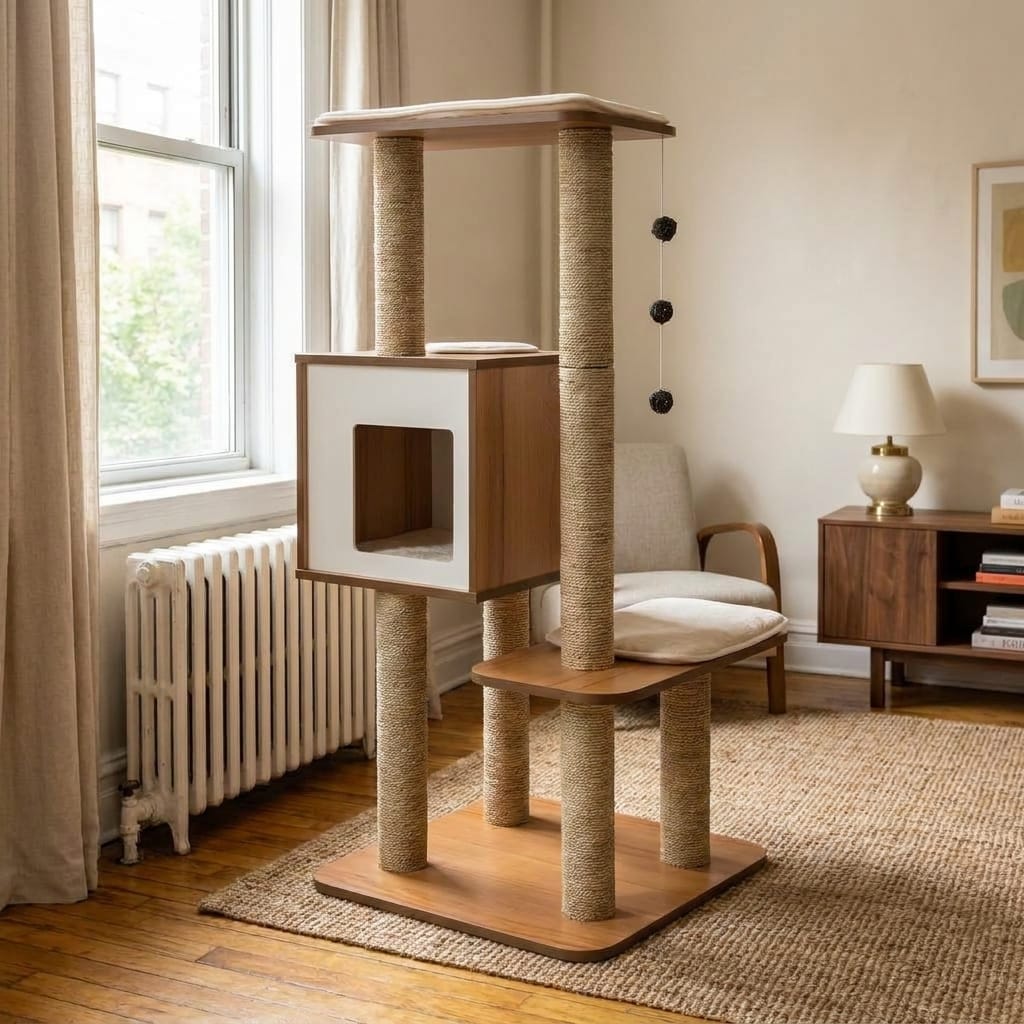 Top pickCatit Vesper V-High Base (Walnut) Top pickCatit Vesper V-High Base (Walnut) | Reads as: Modern tower | Made of: Engineered wood, walnut-look finish | Footprint: Not confirmed. Boxy base; measure your corner span. Maker’s size: 22.1 × 22.1 in overall, 47.8 in tall (opens in a new tab). Boxy, architectural silhouette with memory-foam cushions and replaceable parts |
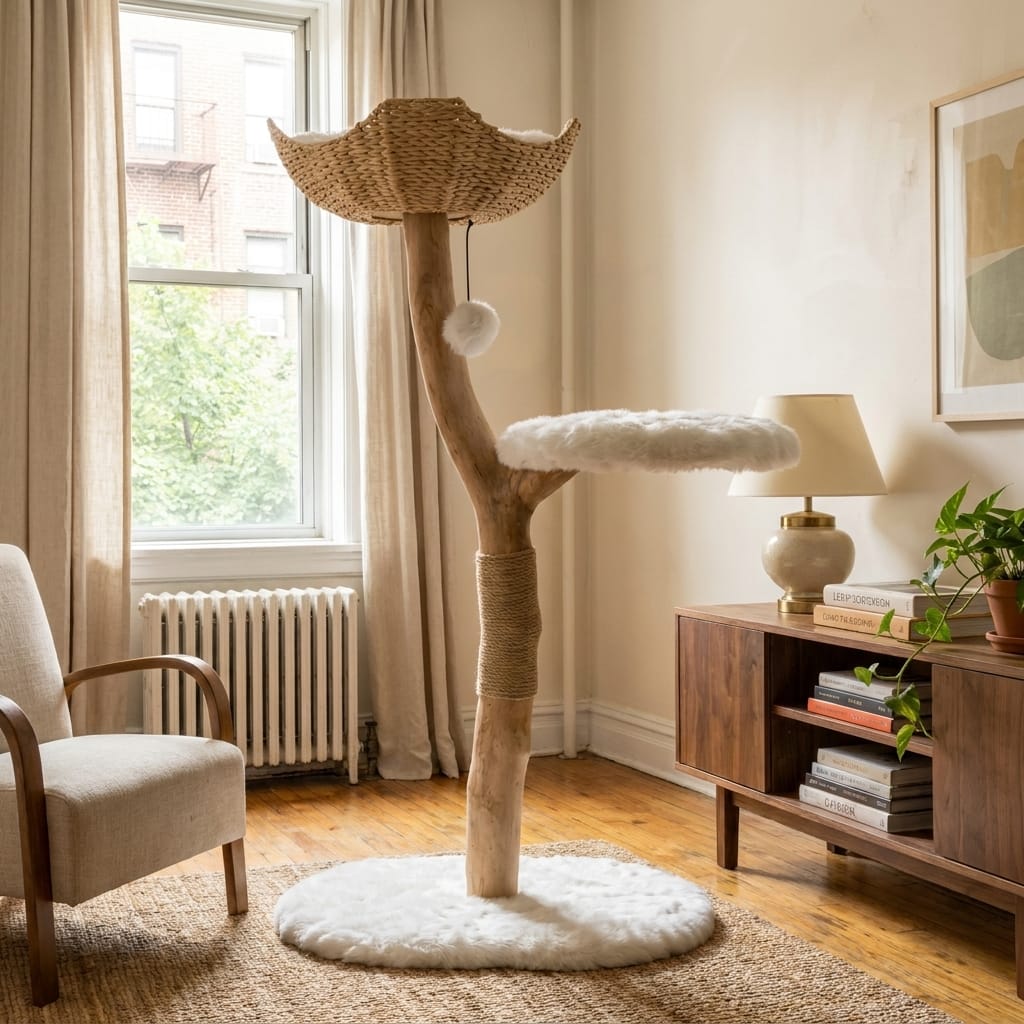 Runner-upMau Modern Wood Cat Tree Tower Runner-upMau Modern Wood Cat Tree Tower | Reads as: Compact tower | Made of: Real pear-wood branch + woven basket | Footprint: 2 of 4. Compact; made for small spaces. Maker’s size: 23.5 in × 18 in base, 43-46 in tall (opens in a new tab). Genuine wood branches and a hand-woven basket bed that reads as decor |
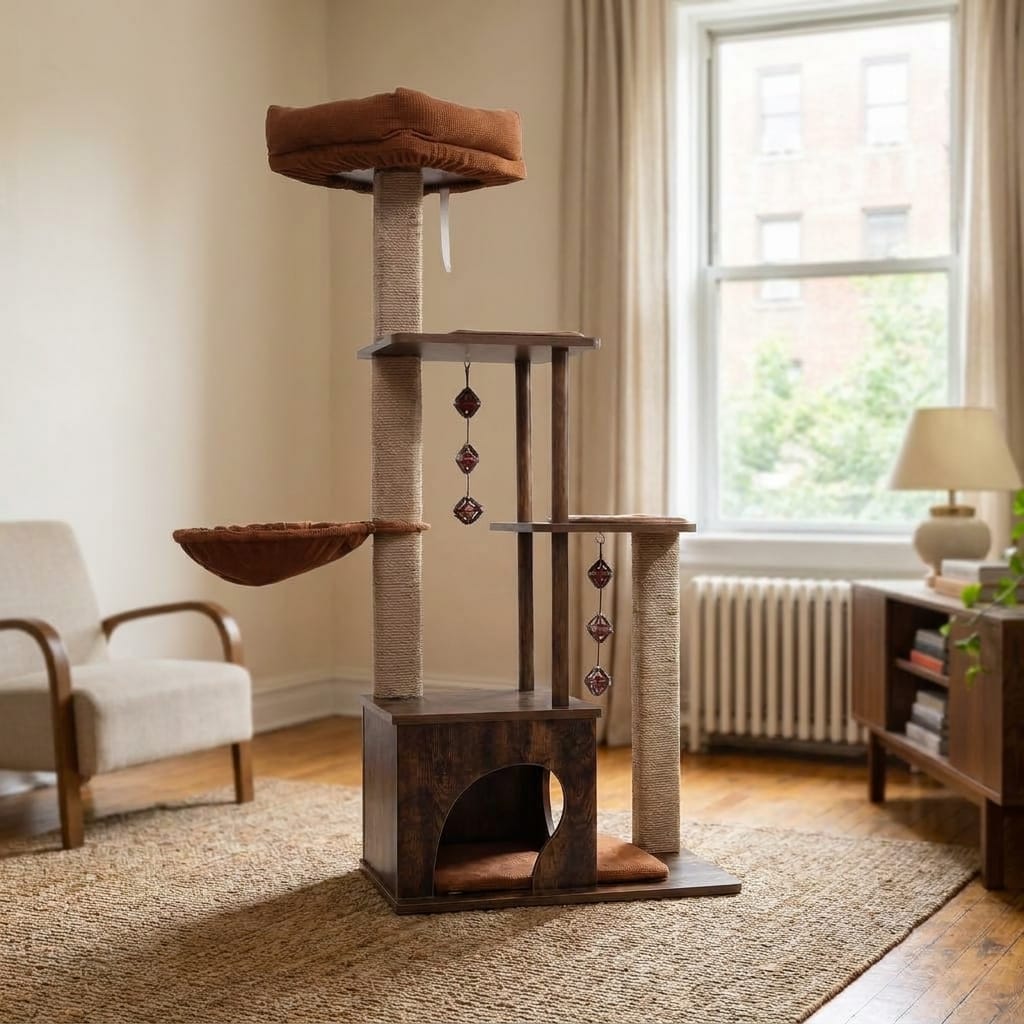 FUKUMARU Retro-Modern 53.5" Cat Tree FUKUMARU Retro-Modern 53.5" Cat Tree | Reads as: Multi-level tower | Made of: Rubberwood plywood + veneer, jute posts | Footprint: Not confirmed. Tall tower; base not stated. Maker’s size: 26.3 × 15.7 in base, 53.5 in tall (opens in a new tab). Warm retro-wood veneer with a condo and hanging hammock |
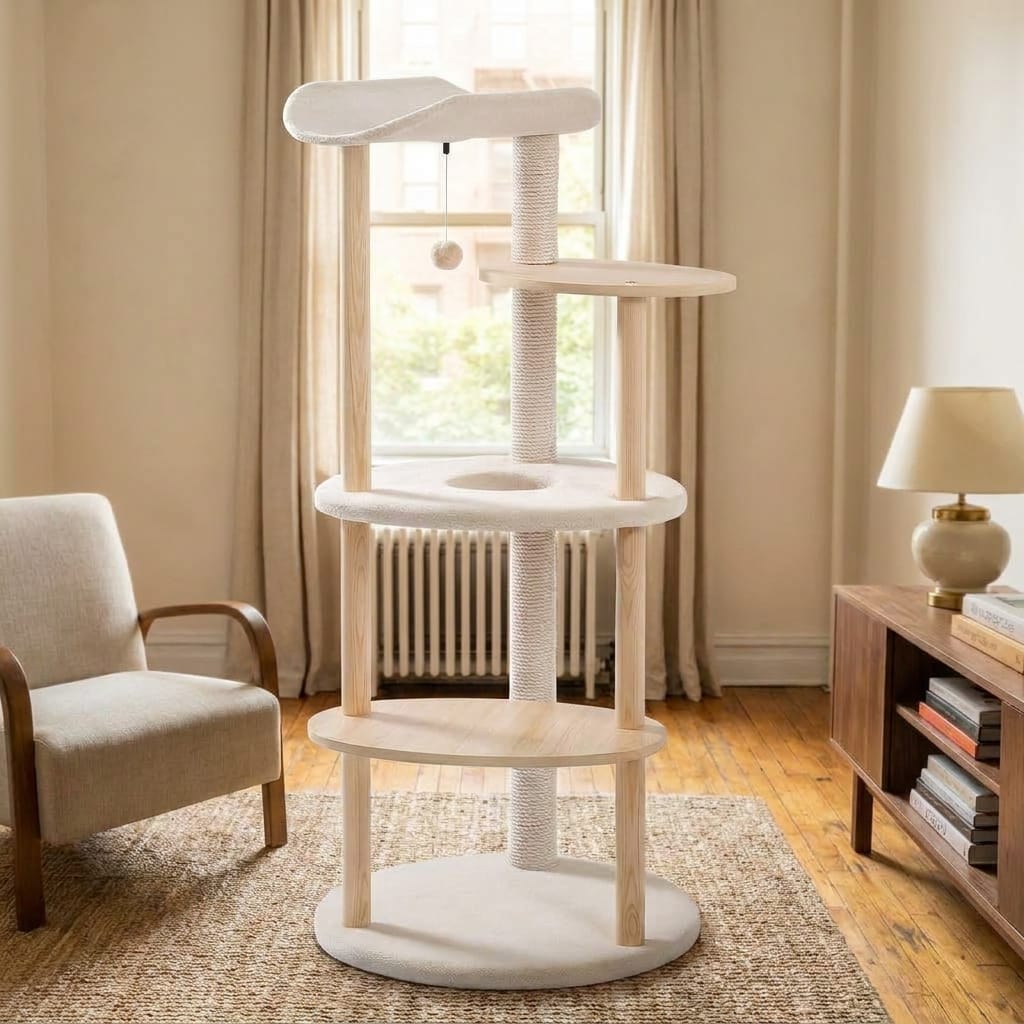 PETEPELA 5-Level Wood Cat Tree PETEPELA 5-Level Wood Cat Tree | Reads as: Sculptural tower | Made of: Wood platforms + sisal posts | Footprint: Not confirmed. Multi-level, not a low wide base. Irregular wood platforms that look intentional, not utilitarian |
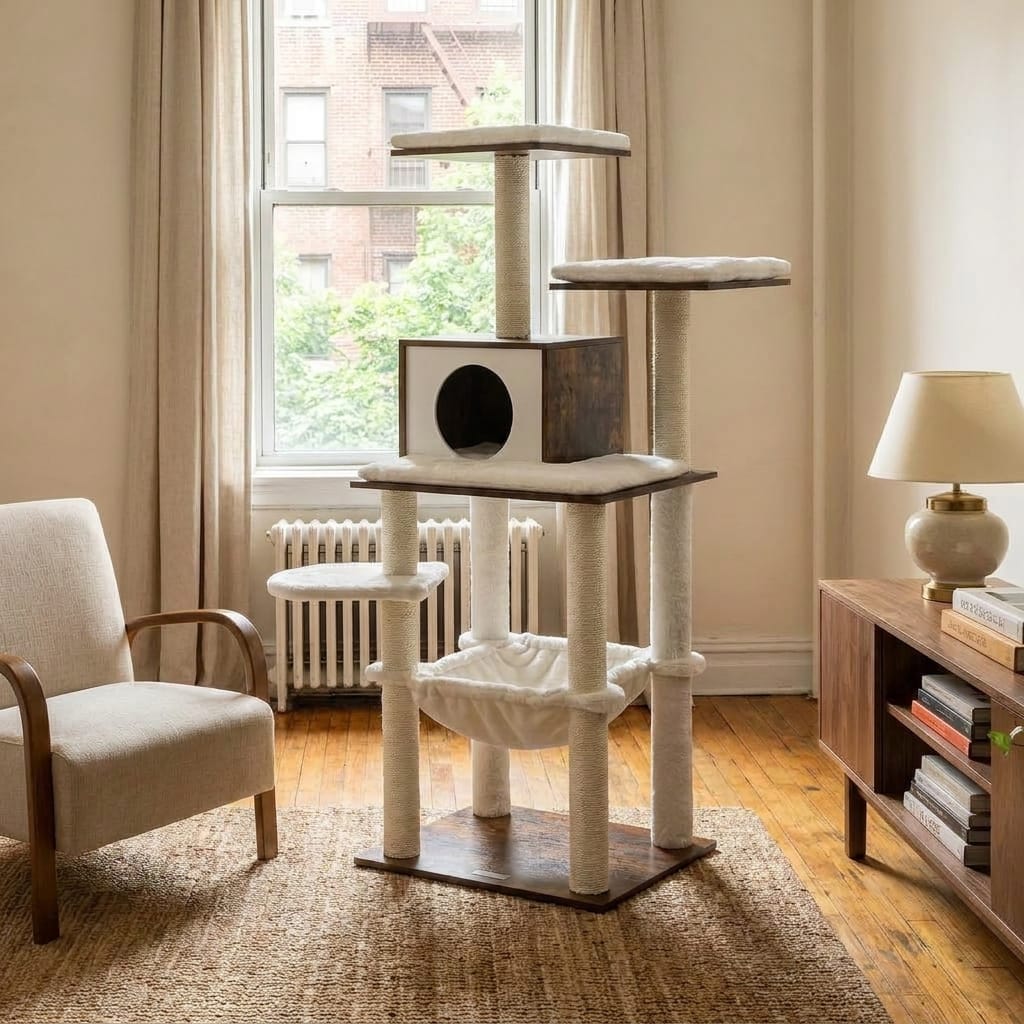 FEANDREA WoodyWonders 56.3" Cat Tower FEANDREA WoodyWonders 56.3" Cat Tower | Reads as: Multi-level tower | Made of: Engineered wood frame + plush | Footprint: 4 of 4. Wide multi-level base. Wood-frame look with a hammock, washable cushions, and an anti-tip kit |
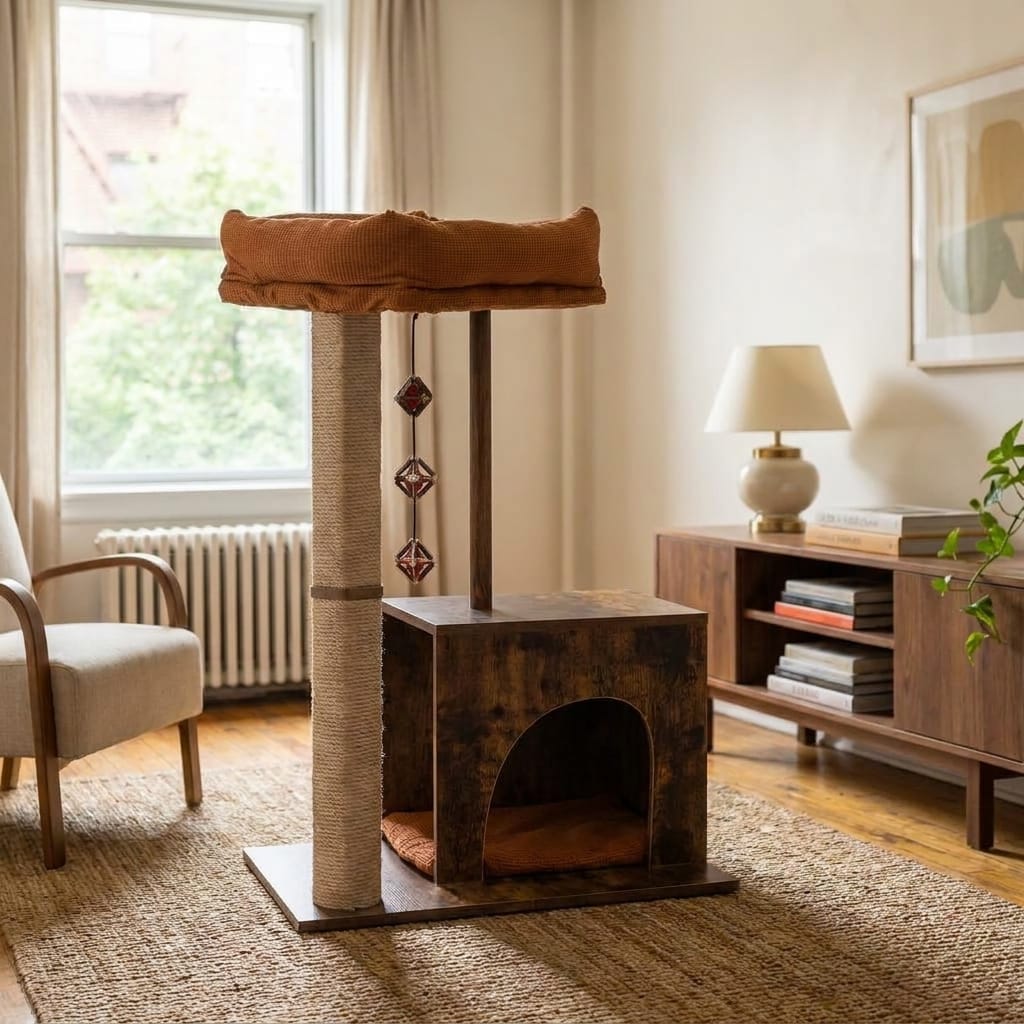 FUKUMARU Small Wooden Cat Tree (32.6") FUKUMARU Small Wooden Cat Tree (32.6") | Reads as: Compact tower | Made of: Solid wood + sisal post | Footprint: 1 of 4. Genuinely small; for tight corners. Maker’s size: 21 × 16.3 in base, 32.6 in tall (opens in a new tab). A genuinely small footprint that still looks like furniture |
Catit Vesper V-High Base (Walnut)
If one cat tree convinced the design world that the category could grow up, it’s the Vesper. The V-High Base is the tall one: a boxy, architectural tower in a warm walnut-look finish, with clean lines, a top platform, a hideaway den, and jute-wrapped scratching posts instead of carpet. The cushions use memory foam, and Catit sells replacement parts for the posts, cushions, and toys, a genuinely nice touch for something that takes daily abuse. It’s the pick when you want the tree to look deliberately placed, like a piece you chose, not tolerated.
- Right for
- The most convincing “designer furniture” look
Before you buy
Engineered wood with a laminate finish, not solid walnut, so the material is nicer to look at than to scrutinize up close. Some reviewers find the platforms compact for a large cat; check the perch dimensions against your cat’s size on the latest listing.
The other six, and why they are not the pick
Every one of these is a real product I would link to for the right person. None of them is the one I would put in this room, and the specific reason is under each.
Measure first, for any of these: the corner or wall span against the base dimensions, not just the height.
AI illustration
Also recommended
FUKUMARU Retro-Modern 53.5" Cat Tree
Right for: A taller wood-tone tower with a hammock
- Reads as Multi-level tower
- Made of Rubberwood plywood + veneer, jute posts
- Maker’s size 26.3 × 15.7 in base, 53.5 in tall (opens in a new tab)
Why it is not the pick: Veneer over plywood rather than solid wood, so treat it as a wood-look piece, not heirloom furniture.
Check price: FUKUMARU Retro-Modern 53.5" Cat Tree — opens Amazon in a new tab
AI illustration
PETEPELA 5-Level Wood Cat Tree
Right for: Active climbers who still want the wood look
- Reads as Sculptural tower
- Made of Wood platforms + sisal posts
Why it is not the pick: Taller multi-level trees can feel less planted than a low, wide base; check reviews for wobble reports and use any included anti-tip hardware.
Check price: PETEPELA 5-Level Wood Cat Tree — opens Amazon in a new tab
AI illustration
FEANDREA WoodyWonders 56.3" Cat Tower
Right for: Wood-tone pick with plush comfort
- Reads as Multi-level tower
- Made of Engineered wood frame + plush
Why it is not the pick: Engineered wood with more plush than the wood-purist picks, so it reads slightly more “cat product.” Tall and multi-level, so anchor it and check the top-perch size for a large cat on the current listing.
Check price: FEANDREA WoodyWonders 56.3" Cat Tower — opens Amazon in a new tab
AI illustration
FUKUMARU Small Wooden Cat Tree (32.6")
Right for: Tight corners and small-to-medium cats
- Reads as Compact tower
- Made of Solid wood + sisal post
- Maker’s size 21 × 16.3 in base, 32.6 in tall (opens in a new tab)
Why it is not the pick: Low height and a small condo: a poor fit for large cats or dedicated climbers.
Check price: FUKUMARU Small Wooden Cat Tree (32.6") — opens Amazon in a new tab
FAQ
Do these wood-look cat trees actually hold up to scratching?
The ones with jute or sisal posts do — that’s what those materials are for, and cats generally prefer them to carpet. The wood platforms and frames are for climbing and looks, not scratching. If your cat is a dedicated scratcher, make sure the post is tall enough for a full stretch and check whether the posts are replaceable, or add a dedicated post from my stylish cat scratchers guide.
Will a modern cat tree be sturdy enough for a big cat?
It depends on the base and the height. Wide, heavy bases stay planted; tall trees on small bases wobble. For a large or very active cat, favor a lower center of gravity, use the anti-tip hardware, and confirm the weight rating on the current Amazon listing before buying.
My cat ignores new furniture. Will she even use it?
Most cats come around if you place it where they already like to be — near a window or their favorite napping corner — and make it appealing with a little catnip or silvervine and a treat on the perch. Put it where the action is, not hidden in a spare room, and give it a week or two.
Solid wood or engineered wood: does it matter?
For looks in photos, barely. For longevity and close-up quality, yes: solid wood and real branches last longer and feel more premium, while veneer and MDF pieces look good but are less forgiving of moisture and heavy impact. Decide how much the material matters to you versus the price.
How big a footprint do these really need?
It varies a lot — from a nightstand-size end table to a wide multi-level base. Always measure your space and check the base dimensions on the listing, since the height in the title tells you nothing about how much floor it eats.
Are the taller towers safe without bolting them to the wall?
Treat wall-anchoring as required for anything tall. Many of these ship with an anti-tip kit; use it. A tree that feels solid when you push it by hand can still tip under a hard landing, and anchoring removes the risk entirely.
When a cat tree is not the answer
If the honest reading of your room is that there is no floor to give up, the right move is not the smallest tower on this page — it is not buying a tower at all. Wall-mounted cat shelves give a cat the same vertical territory with no footprint, and a window perch buys the sunny spot most cats are actually negotiating for. Both cost less than every tree here. And if what your cat wants is somewhere to hide rather than somewhere to climb, cat tree vs cat condo is the comparison that settles it.
That is the outcome I would want told to me, so it is the one this page ends on.